Digital vs Paper Receipts: Official Rules from IRS, HMRC & Accounting Standards

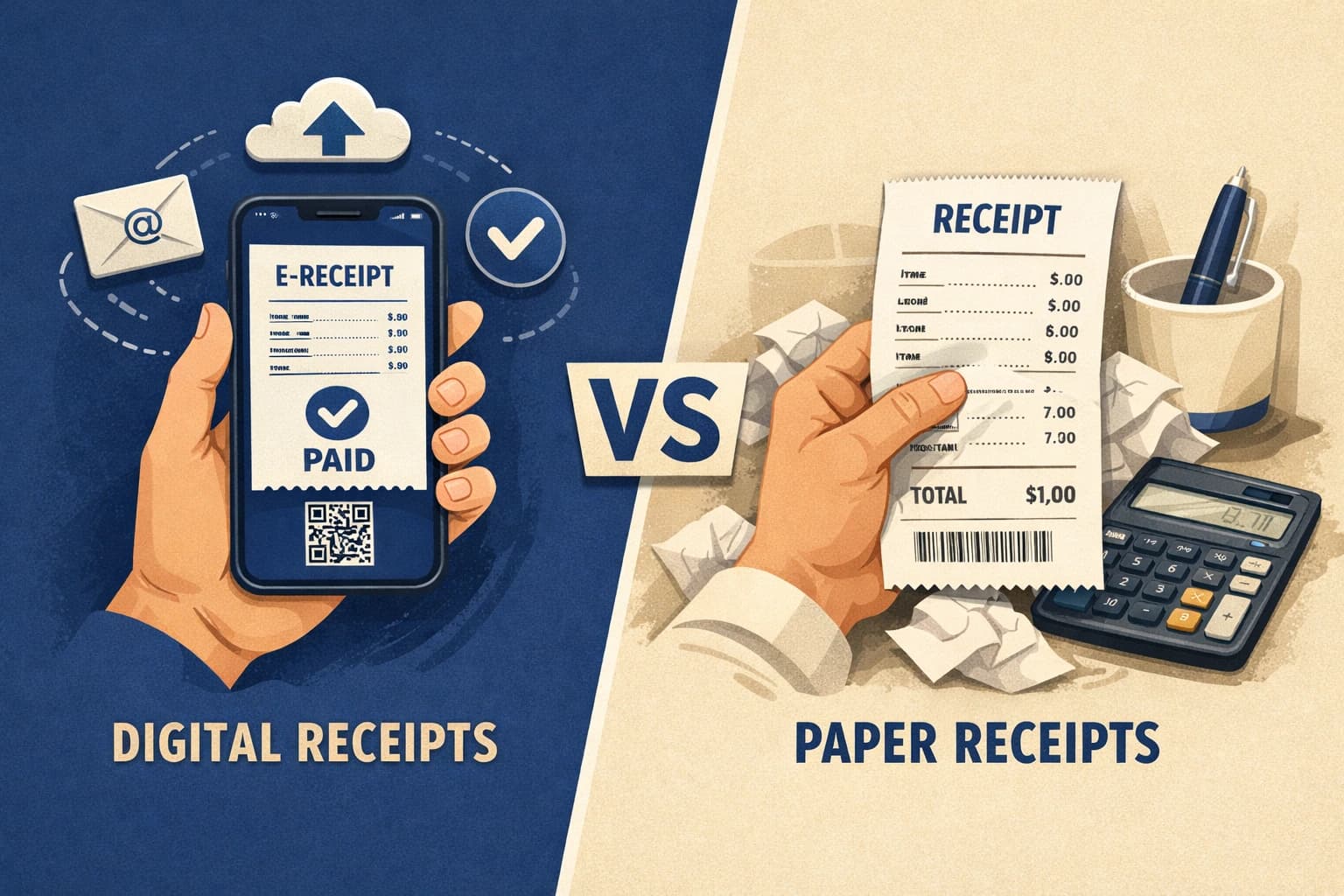
The shift from paper to digital receipts is well underway. Retailers, restaurants, and service providers increasingly offer emailed or app-based receipts instead of — or alongside — traditional printed ones. But when tax season arrives or an auditor knocks, a critical question surfaces: does the tax authority actually accept a digital copy?
The answer depends on where your business operates and which standards apply. In this guide we break down the official positions of the IRS, HMRC, major accounting frameworks, and EU regulators so you can store receipts with confidence. If you need to generate compliant receipts right now, try our free receipt maker.
IRS Rules on Digital vs Paper Receipts
The IRS has accepted electronic records since Revenue Procedure 98-25, which established that digital copies carry the same legal weight as paper originals — provided certain conditions are met. This was later reinforced by Rev. Proc. 97-22 and IRS Publication 583.
"The IRS doesn't distinguish between a paper receipt and a properly stored digital one," says Kellan A. Pilot, a certified accountant with 16 years of experience. "What matters is that the record is complete, legible, and accessible for the full retention period."
Key IRS Requirements
- The $75 rule: For business expenses under $75, a receipt is not technically required — but keeping one is strongly recommended. Meals and lodging always require a receipt regardless of amount.
- Acceptable formats: Scanned images, PDFs, photographs of receipts, email receipts, and app-based records are all accepted.
- Legibility: The digital copy must accurately reproduce the original, including all line items, dates, amounts, and vendor details.
- Retention period: Generally 3 years from the date you file the return, or 6 years if you under-report income by more than 25%. See the IRS record-keeping guidance.
- Backup and access: Records must be readily available for IRS review. Cloud storage, external drives, and accounting software all qualify as long as the data can be retrieved promptly.
If you're creating professional receipts for your business, make sure each one includes the date, vendor name, itemised list, total amount, and payment method — these are the fields the IRS looks for during an audit.
HMRC Rules (UK)
In the UK, HMRC's position is outlined in VAT Notice 700/21 and the broader Making Tax Digital (MTD) framework. HMRC explicitly allows businesses to store digital copies of receipts and invoices instead of paper originals.
Key HMRC Requirements
- Digital record-keeping: Under MTD, VAT-registered businesses must keep digital records using compatible software. Paper-only record-keeping is no longer sufficient for VAT purposes.
- Scanning paper originals: You may scan or photograph paper receipts and discard the originals, provided the digital copy is a complete and readable reproduction.
- Retention period: VAT records must be kept for at least 6 years. Income and Corporation Tax records must be kept for at least 5 years after the 31 January submission deadline.
- Integrity: Digital records must be stored in a way that prevents unauthorised alteration. HMRC may request access to the digital files during a compliance check.
- Format: There is no mandated file format — PDFs, images (JPEG, PNG), and records within accounting software are all acceptable. See the GOV.UK guidance on record-keeping.
For UK businesses looking to create compliant receipts, our receipt templates are designed with the required fields for VAT compliance.
GAAP and IFRS Accounting Standards
Accounting standards don't dictate the physical format of source documents, but they do require that supporting evidence for transactions be retained and verifiable.
US GAAP
Under US GAAP, governed by the Financial Accounting Standards Board (FASB), businesses must maintain sufficient documentation to support every journal entry and financial statement line item. The standard does not require paper — digital source documents are fully acceptable as long as they are complete, unaltered, and retrievable.
IFRS
The International Financial Reporting Standards (IFRS) similarly require that entities retain documentation supporting their financial statements. IFRS does not specify paper vs digital; the emphasis is on reliability, completeness, and auditability of the records.
"From an accounting standards perspective, the medium is irrelevant," notes Kellan A. Pilot. "What auditors care about is whether the receipt can be tied to a specific transaction, whether it's complete, and whether it hasn't been tampered with."
EU and International Rules
The European Union has been at the forefront of digital receipt and e-invoicing adoption. The EU VAT Directive (2006/112/EC) establishes that electronic invoices have the same legal standing as paper invoices, provided the authenticity of origin, integrity of content, and legibility are ensured.
- Italy: Mandatory e-invoicing via the Sistema di Interscambio (SDI) since 2019 for all B2B and B2C transactions.
- France: Phased mandatory e-invoicing for all businesses beginning in 2026.
- Germany: Moving toward mandatory structured e-invoicing for B2B transactions.
- India: The GST e-invoicing system requires real-time electronic invoice registration for businesses above certain turnover thresholds.
- Brazil: The Nota Fiscal Eletrônica (NF-e) system has required electronic invoicing since 2008.
The global trend is clear: digital is becoming the default, and in many jurisdictions, it is now mandatory. Businesses that still rely exclusively on paper are increasingly out of step with regulatory expectations.
What Counts as a Valid Digital Receipt
Regardless of jurisdiction, a valid digital receipt must contain specific information to be accepted for tax and accounting purposes. Missing fields can lead to rejected expense claims or disallowed deductions.
Required Fields
- Date of the transaction
- Vendor or supplier name and address
- Description of goods or services purchased
- Itemised list with quantities and unit prices
- Total amount paid (including tax breakdown where applicable)
- Payment method (cash, card, digital wallet)
- Receipt or transaction number
Accepted Formats
- PDF: The most universally accepted format. Easy to store, share, and print if needed.
- Email receipts: Accepted by most tax authorities provided the email contains the required fields.
- App-based receipts: Records stored within payment apps, accounting software, or dedicated receipt apps are valid.
- Scanned images: Photos or scans of paper receipts in JPEG, PNG, or TIFF format.
- Structured data: XML or JSON receipts used in e-invoicing systems (increasingly common in the EU).
Our email receipt generator creates digital receipts with all the required fields, making compliance straightforward.
Paper Receipts: When They're Still Required
While digital receipts are broadly accepted, there are scenarios where paper originals may still be necessary or strongly preferred:
- Certain warranty claims: Some manufacturers still require the original paper receipt for warranty service.
- Court proceedings: In some jurisdictions, courts may require original paper documents as evidence, though this is changing.
- Specific grant or subsidy programmes: Government grant programmes sometimes require original paper receipts for reimbursement.
- Cross-border transactions: When dealing with countries that have not yet adopted digital receipt legislation, paper may be safer.
- Audit disputes: During contested audits, having paper originals alongside digital copies can strengthen your position.
For more on how receipts function as legal evidence, see our guide on receipts as proof of purchase.
Comparison Table: IRS vs HMRC vs GAAP vs EU
The following table summarises how each authority or standard treats digital and paper receipts:
| Authority / Standard | Digital Receipts Accepted? | Paper Required? | Retention Period | Key Reference |
|---|---|---|---|---|
| IRS (US) | Yes — equal legal weight to paper | No | 3–6 years | Rev. Proc. 98-25 |
| HMRC (UK) | Yes — encouraged under MTD | No | 5–6 years | VAT Notice 700/21 |
| US GAAP | Yes — format neutral | No | As long as needed for audit | FASB Standards |
| IFRS | Yes — format neutral | No | As long as needed for audit | IFRS.org |
| EU VAT Directive | Yes — mandated in some countries | No (some exceptions) | Varies by member state (typically 5–10 years) | Directive 2006/112/EC |
How to Transition from Paper to Digital
Moving from paper to digital receipts doesn't have to be disruptive. Here is a practical step-by-step approach:
- 1. Audit your current process: Identify where paper receipts enter your business — point of sale, supplier invoices, employee expenses — and prioritise the highest-volume areas.
- 2. Choose a storage system: Cloud-based accounting software (e.g., QuickBooks, Xero, FreshBooks) or a dedicated document management system. The key is searchability and backup.
- 3. Digitise existing paper records: Use a scanner or a mobile scanning app to capture existing paper receipts. Ensure each scan is legible and properly named or tagged.
- 4. Set up digital receipt capture: Configure your point-of-sale system to issue digital receipts via email or app. Use our receipt generator to generate professional digital receipts.
- 5. Train your team: Make sure employees know the new process for capturing, categorising, and storing receipts.
- 6. Establish a retention policy: Define how long each type of record is kept based on the rules above, and set up automated reminders for disposal.
- 7. Test with your accountant or auditor: Before discarding paper originals, confirm with your tax adviser that your digital storage meets all requirements.
For businesses exploring thermal printing alongside digital, our guide on thermal receipts explains the technology and its limitations.
Conclusion
Every major tax authority and accounting standard now accepts digital receipts. The IRS, HMRC, GAAP, IFRS, and the EU all treat properly stored electronic records as equivalent to paper — and in some cases, digital is now the only option. The key requirements are consistency across all jurisdictions: receipts must be complete, legible, unaltered, and retained for the required period.
If you're ready to modernise your receipt process, start with our free receipt maker or explore our receipt templates for industry-specific formats.