How to Write a Rent Receipt: Required Fields, State Rules and Free Template

Most rent disputes are not arguments about whether rent was paid. They are arguments about when, and about how much. A tenant remembers handing over cash on the 1st; the landlord recorded it on the 8th and charged a late fee. Without a receipt, that disagreement is two people’s memories, and it is usually resolved by whoever kept better records.
A rent receipt closes that gap. It is a short document — eight fields, a signature — but it is the only contemporaneous evidence of a payment date, and it is the document that housing courts, benefits agencies and mortgage underwriters all ask for. This guide covers what belongs on one, where the law requires them, and the details that decide disputes.
Who Actually Needs One
It is easy to assume rent receipts are a formality for the landlord’s own bookkeeping. In practice the tenant usually needs them more, and for reasons that arrive months or years later:
- Proof of on-time payment in a non-payment or eviction case, where the payment date is frequently the entire dispute.
- Renters’ tax credits. Several states — including New York, New Jersey, Minnesota, Vermont, Wisconsin and Michigan — operate property tax credits or rebates for renters that require documented rent paid.
- Housing benefit and voucher programmes, which verify rent paid before recalculating awards.
- Rental history for a mortgage or a new tenancy, where twelve months of receipts is the standard evidence of a payment record.
- Immigration and residency applications, which commonly accept rent receipts as proof of address over a period.
For the landlord the case is simpler but no weaker: receipts are what turn a bank statement into an auditable rental income record, and they are the first thing requested if rental income is ever queried.
The Eight Fields Every Rent Receipt Needs
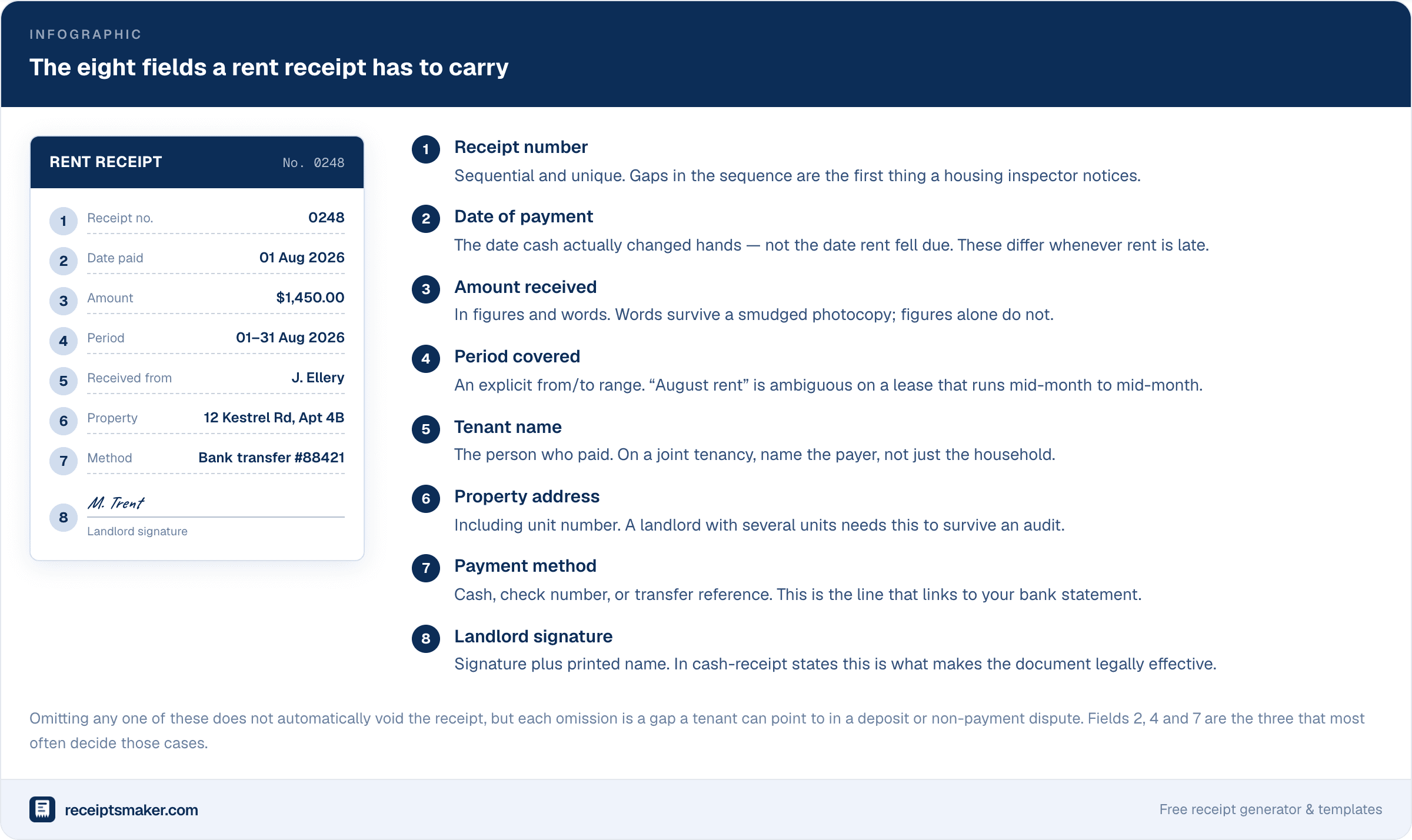
The fields themselves are set out in the infographic above. What follows is why three of them decide most disputes — because these are the ones landlords routinely abbreviate.
The date paid, not the date due
This is the field that matters most and the one most often filled in wrongly. The receipt must record the date the money actually changed hands. When rent is late, the payment date and the due date differ — and that difference is precisely what a late-fee dispute turns on. A receipt that records "August rent" without a payment date proves that rent was paid at some point, which is rarely the contested question.
An explicit period, expressed as a range
Write "1–31 August 2026", not "August rent". The distinction matters on any tenancy that does not run calendar-month to calendar-month, on partial first and last months, and on any pro-rated payment. It also removes the ambiguity that arises when a tenant pays two months at once — one receipt covering an explicit two-month range is unambiguous in a way that two receipts labelled by month are not.
The payment method and its reference
Record cash as cash, a cheque by its number, and a transfer by its reference. This is the field that links the receipt to independent evidence. A receipt saying "bank transfer #88421" can be corroborated against a statement years later; one saying "paid" cannot. For cash — where no independent trail exists at all — the receipt becomes the only record, which is why cash rent attracts the strictest legal treatment.
Where the Law Requires a Rent Receipt
There is no federal requirement in the US. Obligations are set at state and sometimes city level, and they fall into three broad patterns.
| Pattern | Examples | What it means in practice |
|---|---|---|
| Always required for cash | Most states with any rule at all | Where rent is paid in cash, a written receipt must be provided — this is the most widespread requirement by far. |
| Required on tenant request | New York, Massachusetts, Washington, Maryland | The landlord must supply a receipt when asked, regardless of payment method. In New York, receipts are required for cash without a request being needed. |
| Required for every payment | Certain rent-regulated units and some city ordinances | Applies particularly to rent-stabilised housing and to some municipal codes that go beyond state law. |
Two things follow from this that are worth stating clearly. First, cash is the universal trigger — if a tenant pays in cash, assume a receipt is required and issue one without waiting to be asked. Second, city ordinances routinely impose more than state law, so a landlord operating in a regulated market should check the municipal code rather than stopping at the state statute.
Because these rules change and vary by municipality, verify your own position against your state landlord-tenant statute and any local ordinance before relying on a general summary — including this one. The Consumer Financial Protection Bureau and HUD both publish current state-by-state starting points.
Outside the US the picture differs again: in India rent receipts are required to claim House Rent Allowance and must carry a revenue stamp above a threshold, while in much of Europe the receipt requirement is folded into general invoicing rules rather than housing law.
A Template You Can Use
The wording below covers every required field. It is deliberately plain — a rent receipt gains nothing from formality, and anything that obscures the eight facts makes it less useful.
RENT RECEIPT — No. 0248. Received on 1 August 2026 from J. Ellery the sum of one thousand four hundred and fifty dollars ($1,450.00), being rent for the period 1 August 2026 to 31 August 2026 in respect of 12 Kestrel Road, Apartment 4B. Paid by bank transfer, reference 88421. Balance outstanding: none. Signed, M. Trent, Landlord.
Three refinements make a real difference over time:
- Number receipts sequentially and never reuse a number. A continuous sequence demonstrates a complete record. Gaps invite the question of what happened to the missing one.
- State the balance outstanding, even when it is zero. "Balance: none" forecloses a later claim of partial payment. On a partial payment, stating the remaining balance turns the receipt into an acknowledgement of the debt as well as the payment.
- Issue two copies and keep one. A receipt held only by the tenant proves the tenant’s case, not yours.
You can generate a formatted version of exactly this document from our rent receipt templates, or build one field by field in the receipt generator.
Cash Rent: The Case That Needs the Most Care
Cash removes every independent record. There is no statement, no cleared cheque, no transfer reference — only the receipt. That makes the receipt the entire evidential basis for the payment on both sides, and it is why cash triggers a receipt requirement in nearly every jurisdiction that has one.
Four practices make cash rent defensible:
- Issue the receipt at the moment of payment, in the tenant’s presence. A receipt written up later is a reconstruction, and looks like one.
- Write the amount in words as well as figures. Words cannot be altered by adding a digit, and they survive a poor photocopy.
- Have both parties sign where the sum is significant. A tenant’s signature acknowledging the amount handed over removes the most common cash dispute entirely.
- Deposit cash promptly and reference the receipt number on the deposit. This is what reconnects cash rent to a bank record, and it is the step that makes rental income straightforward to substantiate later.
If a cash payment was taken and no receipt was issued at the time, do not backdate one. Write a dated statement recording what happened and when, and have both parties sign it — the same approach we set out in our guide to the missing receipt declaration. A contemporaneous statement about a past event is honest evidence; a backdated receipt is a fabricated document, and its discovery destroys the credibility of every other record you hold.
Digital Rent Receipts and Retention
Emailed and PDF rent receipts are accepted everywhere paper ones are, provided they are complete and legible. The email itself adds something a paper receipt lacks: a timestamped delivery record showing the tenant received it, which is independently useful in a dispute.
On retention, rent receipts sit at the long end of the scale. Rental income records generally follow the same windows as other business records — six years in the UK and Canada, three to six in the US depending on circumstances — but tenancy deposit disputes, statutory limitation periods on contracts, and mortgage underwriting requests all reach back further. Our guide to how long to keep receipts sets out how these overlapping clocks interact; for rent, the practical answer is to keep the full set for the life of the tenancy plus at least six years.
One material advantage of issuing rent receipts digitally: they do not fade. A handwritten receipt from a carbonless duplicate book is durable, but a receipt printed on thermal paper will be substantially illegible well before a six-year window closes.
Conclusion
A rent receipt is a small document carrying disproportionate weight. Eight fields, issued at the moment of payment, signed and numbered in sequence — that is the whole discipline, and it resolves the payment-date arguments that make up most rent disputes before they start.
Record the date paid rather than the date due, express the period as an explicit range, name the payment method and its reference, and never leave cash rent undocumented. If you would rather not write them by hand each month, our rent receipt templates produce a numbered, complete receipt in about a minute.