How Long to Keep Receipts: Retention Rules by Country and Document Type

Ask an accountant how long to keep receipts and you will usually hear "three years". It is a reasonable default and it covers the majority of routine expenses. It is also the wrong answer often enough that businesses shred documents they later need — and, just as expensively, keep a decade of supermarket slips that nobody will ever ask for.
The retention period is not a property of the receipt. It is a property of the claim the receipt supports. A £4 coffee and a £40,000 machine can appear on identical paper, but one is disposable after three years and the other has to survive until the asset is sold and then some. This guide sets out the windows that actually apply, and — more usefully — when the clock starts.
When the Clock Actually Starts
This is the detail that trips people up most, and getting it wrong shortens your retention by up to a year.
The period does not run from the date on the receipt. It runs from the filing of the return that the receipt supports — specifically, from the later of the date you filed or the date the return was due. A receipt dated 3 March 2026 supports a return filed in April 2027. The three-year clock starts in April 2027, not March 2026. That receipt is live until 2030, not 2029.
Two consequences follow. First, filing early does not start the clock early — the due date floors it. Second, filing late extends your exposure, because the clock starts when you actually file. A return filed two years late carries a retention obligation running five years from the original due date.
And if a return is never filed, or is filed fraudulently, there is no limitation period at all. The IRS can assess tax indefinitely in those cases under Internal Revenue Code §6501. HMRC applies a comparable 20-year window for deliberate understatement.
United States: IRS Retention Windows
The IRS publishes its periods as a set of conditional rules rather than a single number. In practice they resolve to this:
| Situation | Keep for | Why |
|---|---|---|
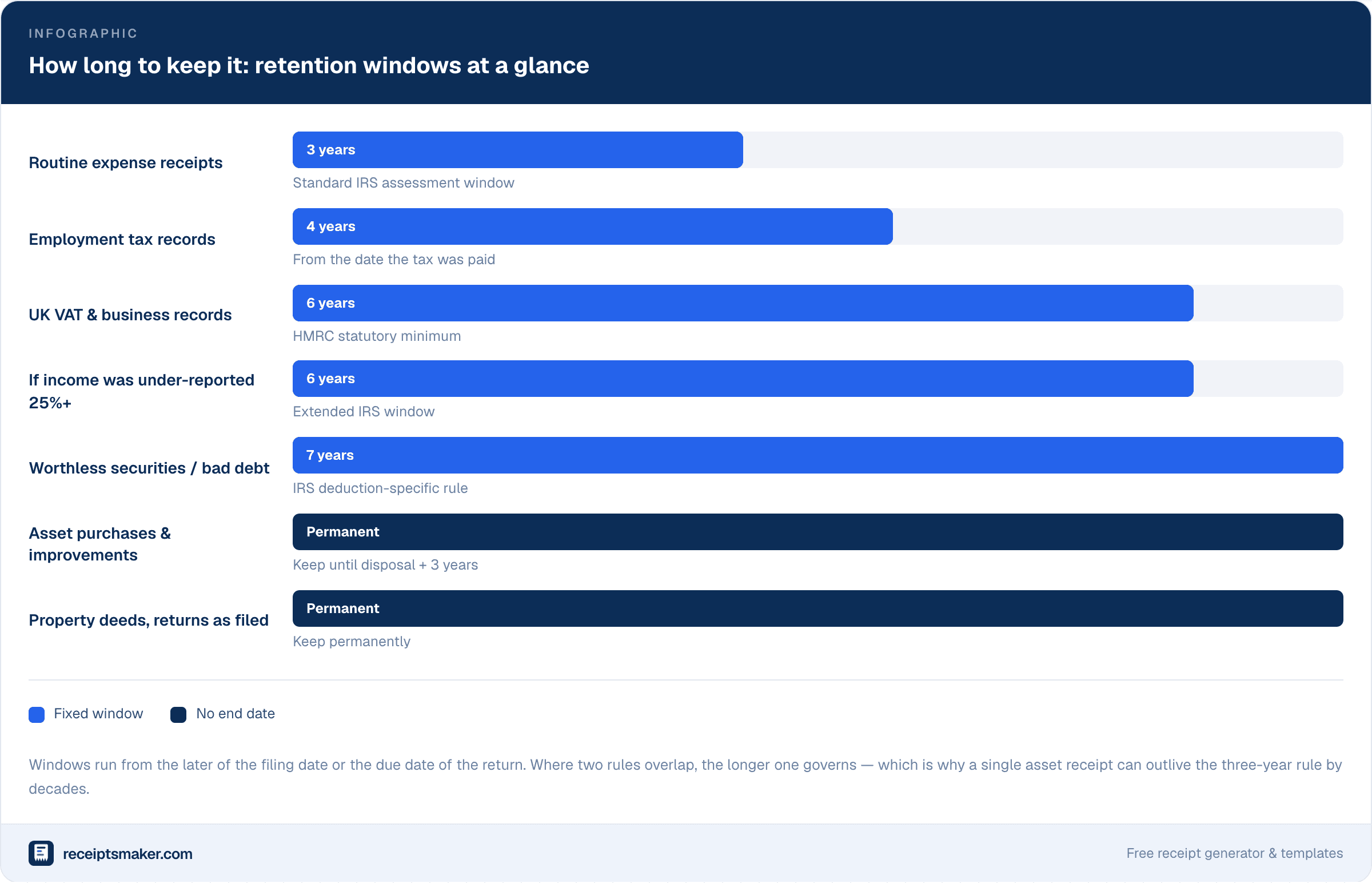
| Ordinary business expenses | 3 years | The standard assessment period under §6501(a) |
| Income under-reported by more than 25% | 6 years | Extended assessment period under §6501(e) |
| Employment tax records | 4 years | From the date the tax was paid or became due |
| Claims for worthless securities or bad debt | 7 years | Deduction-specific rule |
| Property, equipment and improvements | Life of asset + 3 years | Needed to compute basis and depreciation recapture on sale |
| No return filed, or a fraudulent return | Indefinitely | No limitation period applies |
The asset row is the one most small businesses get wrong. Depreciation is claimed over many years, and when the asset is finally sold the gain is computed against its original cost. A 2010 purchase invoice for a van sold in 2028 is still a live document in 2031. Filing it under "2010" and shredding it on a three-year cycle destroys the evidence for a deduction you are still claiming.
Note also the $75 threshold, which is frequently misread. Under IRS rules a receipt is not strictly required to substantiate a business expense under $75 — but the expense itself must still be recorded, and lodging is excluded from the concession regardless of amount. The threshold removes the paper requirement, not the record-keeping requirement. We unpack the substantiation rules further in receipts as proof of purchase.
United Kingdom: HMRC Retention Windows
HMRC’s periods are longer than the American equivalents and, helpfully, more uniform.
- VAT records — 6 years. This covers invoices issued and received, import and export documents, and the VAT account itself. See the GOV.UK VAT record-keeping guidance.
- Limited company records — 6 years from the end of the accounting period, under the Companies Act 2006.
- Self-employed and partnership records — 5 years after the 31 January submission deadline of the relevant tax year.
- PAYE records — 3 years from the end of the tax year they relate to.
- Deliberate understatement — 20 years. HMRC’s discovery window where behaviour is judged deliberate.
The five-year rule for the self-employed catches people out because it is expressed relative to a submission deadline rather than the transaction. Records for the 2025–26 tax year support a return due 31 January 2027, and must be kept until 31 January 2032 — nearly seven years after the earliest transactions in that year.
Making Tax Digital adds a format dimension rather than a duration one. VAT-registered businesses must keep records digitally in compatible software, though the underlying retention period is unchanged. Scanning paper originals and discarding them is explicitly permitted, provided the copy is complete and legible.
Canada and Australia
Both jurisdictions run longer default windows than the US, and both are more prescriptive about where records physically live.
| Jurisdiction | Standard period | Notable conditions |
|---|---|---|
| Canada (CRA) | 6 years | From the end of the last tax year the records relate to. Records must generally be kept in Canada unless the CRA grants written permission to hold them abroad. |
| Australia (ATO) | 5 years | From the date the record was prepared or the transaction completed, whichever is later. Records must be in English or readily convertible. |
| Ireland (Revenue) | 6 years | From the end of the accounting period. |
| Germany | 8–10 years | Invoices 8 years under recent reform; accounting books and annual statements 10 years under the HGB. |
The Canadian residency condition is unusual and genuinely catches cloud-first businesses: storing your only copy on a server outside Canada without permission is a compliance issue in itself, independent of how long you keep it.
The Non-Tax Reasons, Which Often Run Longer
Tax is only one of several clocks running on the same piece of paper, and it is frequently not the longest. It is worth checking all of them before disposing of anything.
- Warranty period. A five-year appliance warranty makes the receipt a live document for five years regardless of tax rules — and the receipt is normally the only accepted proof of purchase date.
- Statutory consumer rights. In the UK, claims for goods not of satisfactory quality can be brought for up to six years in England and Wales, five in Scotland.
- Insurance. Contents claims are assessed on evidence of ownership and value. Receipts for high-value items should be kept for as long as the item is insured.
- Home improvement. Capital improvements adjust the cost basis of a property. Those receipts stay relevant until the property is sold and the resulting return is out of assessment.
- Disputes and litigation. Contractual limitation periods commonly run six years, and independently of any tax window.
The governing principle is simple and worth internalising: where two rules overlap, the longer one wins. A receipt is only disposable when every clock attached to it has run out.
A Retention System That Actually Works
The common failure is not keeping too little. It is keeping everything in one undifferentiated pile, which makes disposal impossible and retrieval slow. A workable system separates records by how long they need to live, not by when they arrived.
- Tier 1 — routine expenses. Consumables, travel, meals, supplies. Filed by tax year, disposed of as a block once the longest applicable window closes.
- Tier 2 — payroll and employment. Kept separately because the four-year clock runs from payment dates rather than the filing date.
- Tier 3 — assets and improvements. Never filed by year. Filed by asset, and kept with that asset until three years after it is disposed of.
- Tier 4 — permanent. Returns as filed, incorporation documents, deeds, major contracts, pension records. These never get a disposal date.
Tier 3 is the one that pays for itself. Most businesses file the purchase invoice for a vehicle under the year it was bought, then destroy it on schedule while still depreciating the vehicle. Filing by asset instead of by year makes that mistake structurally impossible.
A short annual routine keeps the system honest: once a year, close out the tier-1 block that has aged past its window, re-check tier 3 against your asset register, and confirm your backups still restore. Businesses that adopt this rhythm report the same benefit we heard from the operators in how 500 small businesses simplified bookkeeping — the value is less about compliance than about never having to search.
Digital Copies, Fading Paper, and the Practical Problem
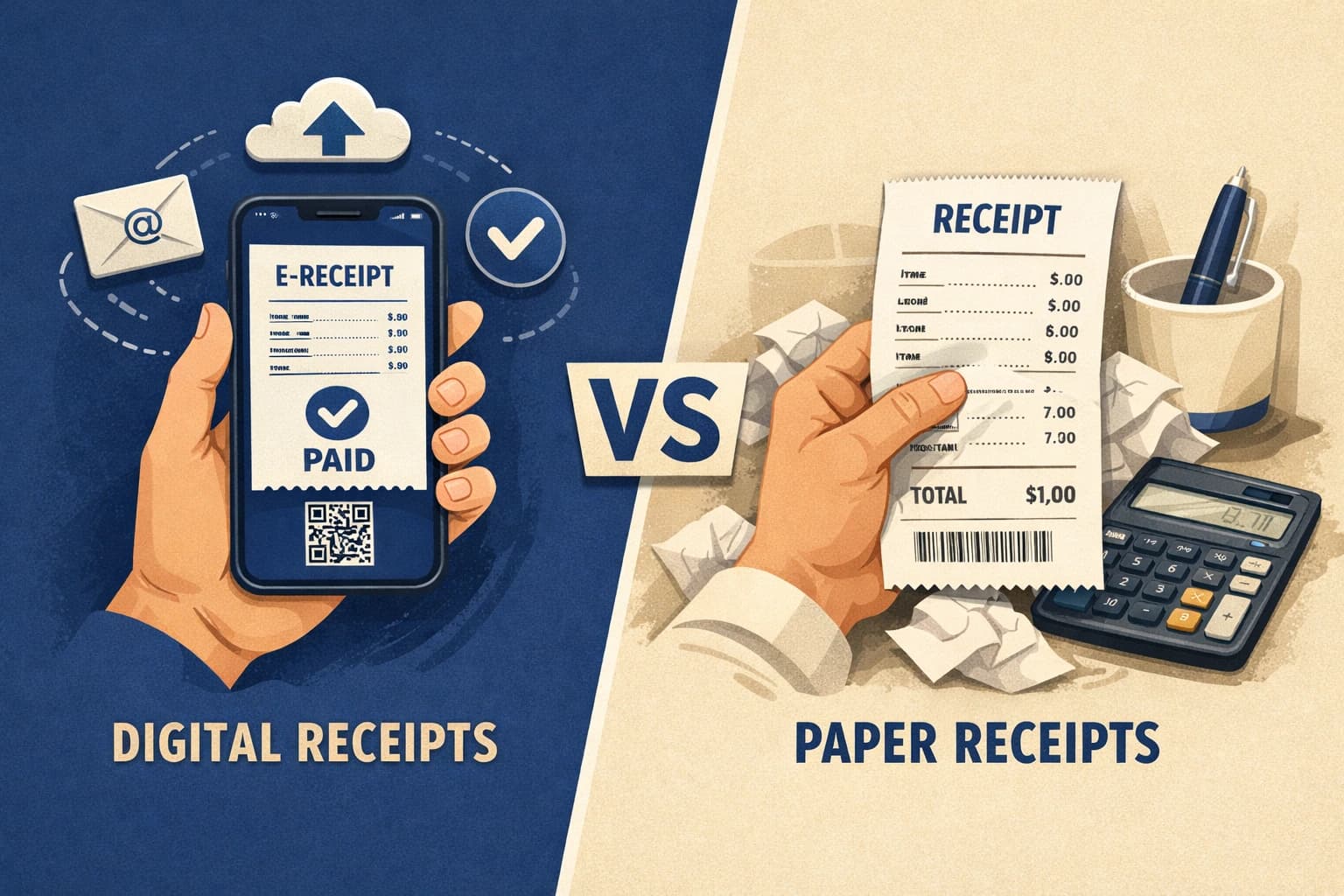
Every major tax authority now accepts digital copies of receipts, provided they are complete, legible and retrievable for the full period. That is settled, and we cover the specific rules in digital versus paper receipts.
The practical problem is that thermal receipts do not survive their own retention window. Thermal print is a heat-triggered chemical reaction, and it degrades with warmth, sunlight, humidity and contact with plasticisers — the PVC in a wallet or document sleeve is a particularly effective way to erase one. Typical legibility is three to five years under good conditions, which is shorter than the six-year windows in the UK, Canada and Ireland.
This is the single most under-appreciated fact in receipt retention. Meeting a six-year obligation with thermal paper is not a filing problem; it is a materials problem. If the underlying record is thermal, digitising it is not a convenience — it is the only way to satisfy the requirement. Scan it in the week it arrives, while it is still fully legible, because a faded receipt scanned in year four preserves nothing.
Where a record has already been lost or has faded past legibility, a written reconstruction supported by corroborating evidence is the standard remedy — see our guide to the missing receipt declaration for the format and the limits of what it can substitute for.
Conclusion
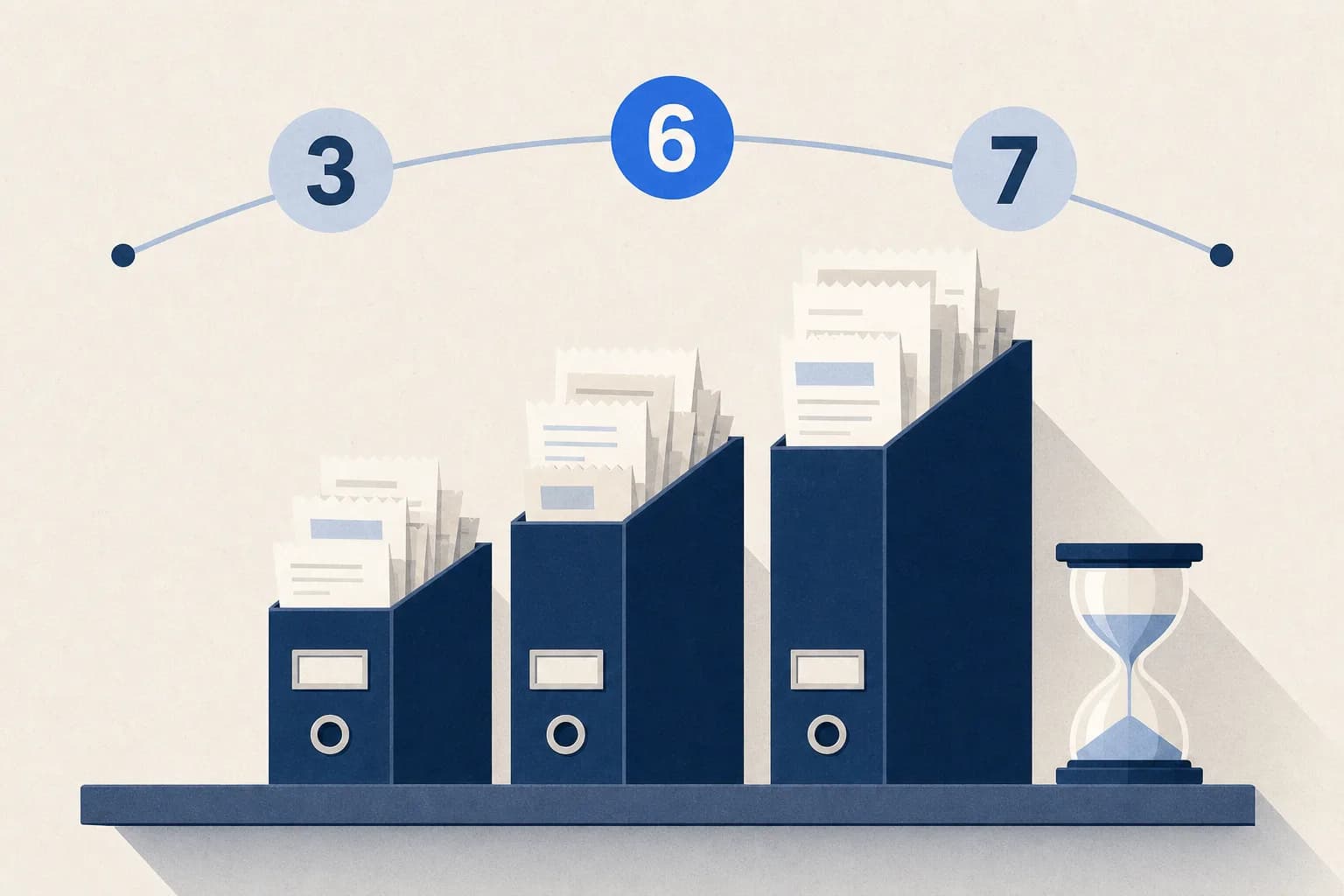
Three years is a serviceable default for ordinary expenses in the US, and six covers most obligations in the UK, Canada and Ireland. But the number that matters is the one attached to the specific claim: assets outlive the general rule by years, employment records run on their own clock, and warranty or litigation periods routinely exceed every tax window on the same slip of paper.
Start the clock from the filing date rather than the receipt date, file assets by asset rather than by year, apply the longer rule wherever two overlap, and digitise anything thermal in the week it arrives. That handles nearly every case — and if you are issuing receipts as well as filing them, our receipt templates and free generator produce documents that carry the fields an auditor will ask for years later.