Receipt vs Invoice vs Bill vs Purchase Order: Which Document Do You Need?

The distinction sounds like pedantry until the first time it costs you something. A supplier who sends a receipt instead of an invoice has no enforceable claim to the money. A business that files an invoice as proof of payment has an expense it cannot substantiate. And a bookkeeper who records both documents for the same transaction has just doubled the expense in the accounts.
Each of these is a real, routine error, and they all come from the same root cause: five documents that look similar, are named inconsistently, and describe different moments in a single transaction. The clearest way to keep them straight is to stop thinking about what they look like and start thinking about where the money is when each one is issued.
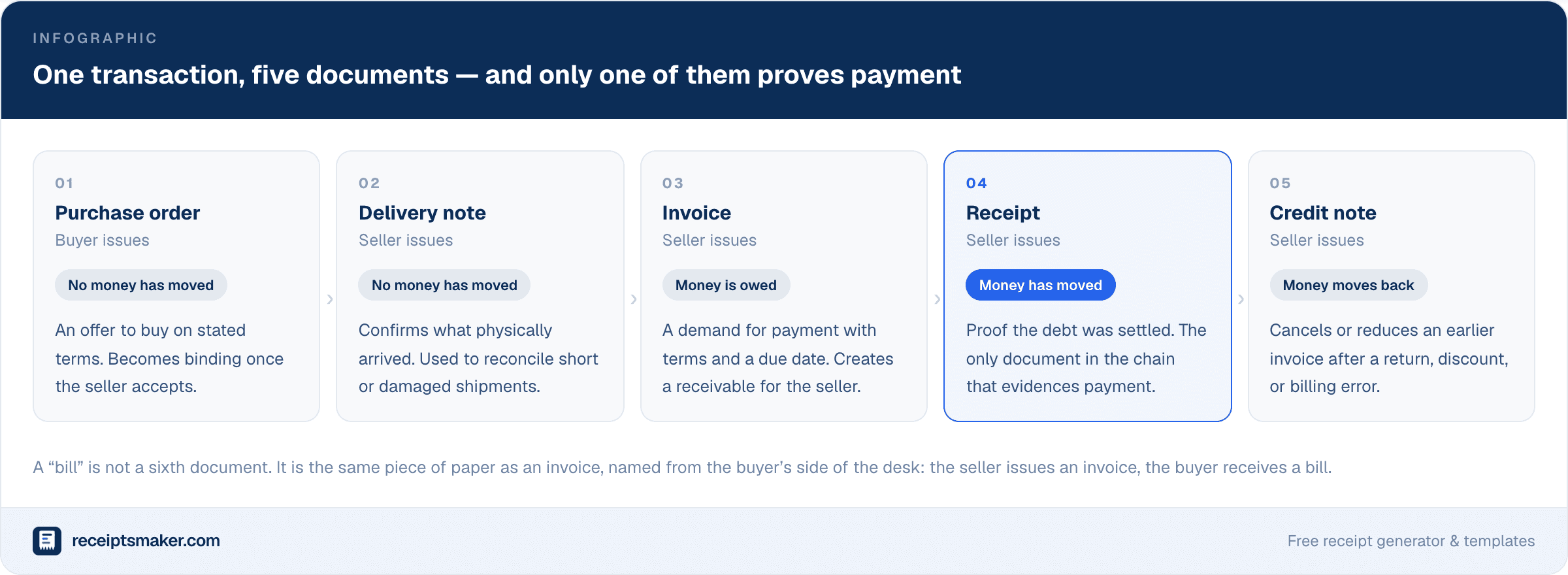
The One Question That Settles It
Before the definitions, here is the test that resolves almost every case in practice. Ask: has the money moved yet?
- Money has not moved and you are asking for it — that is an invoice.
- Money has moved and you are confirming it — that is a receipt.
- Money moved and now needs to move back — that is a credit note or refund receipt.
Everything else is detail. The reason the question works is that it maps onto the accounting treatment exactly: an invoice creates a receivable, a receipt clears one, and a credit note reverses one. Documents that do not move money — purchase orders, delivery notes, quotes — do not touch the ledger at all.
What an Invoice Actually Is
An invoice is a demand for payment. It is issued by the seller after goods or services have been supplied, and it establishes a legal debt: the buyer now owes a stated sum by a stated date.
The features that distinguish it from a receipt all follow from that function. An invoice must carry payment terms and a due date, because it is asserting when payment falls due. It carries a unique sequential invoice number, because it may need to be chased, aged, disputed or written off. And it identifies the buyer by name and address, because a debt has to be owed by someone specific.
In accrual accounting the invoice — not the payment — is what triggers recognition. The seller records revenue and a receivable on the invoice date; the buyer records the expense and a payable. This is why the invoice date matters so much at year end, and why moving an invoice across a period boundary is a genuine accounting question rather than an administrative one.
What a Receipt Actually Is
A receipt is evidence that a payment was made. It is issued after the money has moved, and its job is purely evidential — it creates no obligation on anybody.
That is why a receipt has no due date and no payment terms: there is nothing left to pay. It records the amount actually received, the date it was received, and the method used. Crucially, that amount can differ from the invoice — partial payments, early settlement discounts and overpayments all produce a receipt whose figure does not match the invoice it settles.
A receipt is also the document that tax authorities want when substantiating a deduction, because it evidences that money left the business rather than merely that someone asked for it. An unpaid invoice supports no deduction at all under cash-basis accounting. We cover what makes a receipt hold up under scrutiny in receipts as proof of purchase.
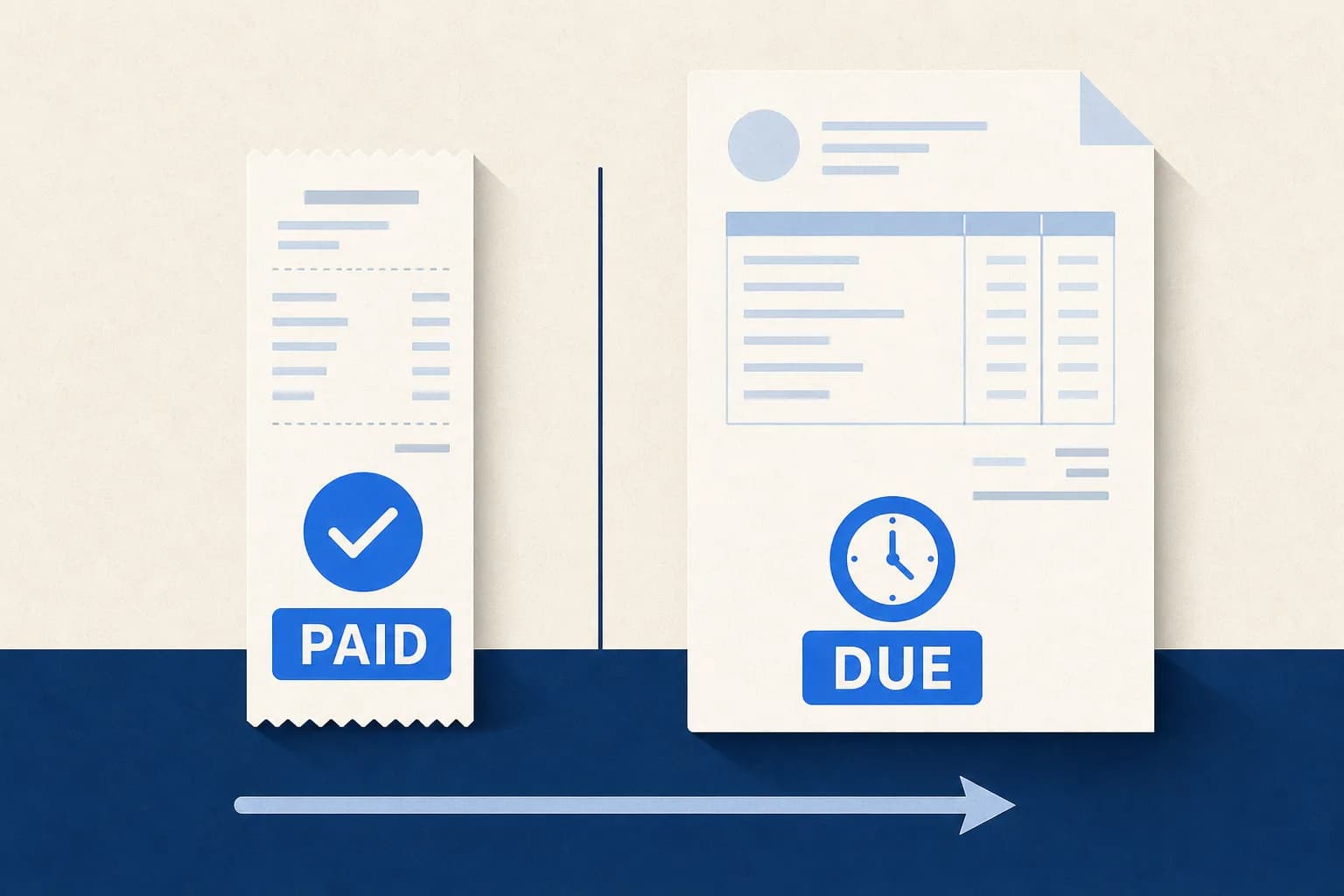
Invoice vs Receipt, Side by Side
| Invoice | Receipt | |
|---|---|---|
| Purpose | Requests payment | Confirms payment |
| Issued | After supply, before payment | At or after payment |
| Creates | A legal debt | No obligation — evidence only |
| Payment terms | Required | Not applicable |
| Due date | Required | Not applicable |
| Buyer details | Required — a debt is owed by someone | Optional on retail sales |
| Sequential number | Legally required in most of Europe | Good practice; required for VAT receipts |
| Ledger effect | Revenue and receivable (accrual) | Clears the receivable, records cash |
| Supports a deduction? | Only under accrual basis | Yes, in both bases |
Is a Bill Different From an Invoice?
No — and this is worth stating plainly, because the confusion is entirely linguistic rather than substantive.
A bill and an invoice are the same document seen from opposite sides of the transaction. The seller issues an invoice; the buyer receives it and calls it a bill. The words encode perspective, not a difference in legal effect.
There is a soft convention worth knowing: "bill" tends to be used where payment is expected immediately and in person — a restaurant bill, a utility bill — while "invoice" implies credit terms and a payment window. But no jurisdiction treats them as distinct instruments, and accounting software reflects this by simply calling incoming invoices "bills". If you receive something labelled a bill, file it exactly as you would an invoice.
Purchase Orders and Delivery Notes
These two sit before the invoice in the sequence, and neither moves money.
A purchase order runs in the opposite direction to everything else: it is issued by the buyer, offering to purchase specified goods on specified terms. Once accepted by the seller it typically forms a binding contract. Its practical value is control — it commits spending to a budget before the money is gone, which is why organisations of any size require a PO number before work begins.
A delivery note accompanies the goods and records what physically arrived. It deliberately omits prices, because the warehouse staff signing for the shipment have no business seeing commercial terms. Its job is to make short deliveries and damage provable at the moment they occur, rather than weeks later when the invoice is queried.
Together with the invoice these form the classic three-way match that underpins accounts payable: purchase order, delivery note, invoice. If all three agree, the invoice is paid. If they do not, something has gone wrong upstream. This single control catches most duplicate billing and over-invoicing before money leaves the business — which is why it survives in almost every finance function despite the paperwork it creates.
Credit Notes and Refund Receipts
When a transaction has to be partly or wholly undone, the correct instrument depends on whether payment has already been made.
- Credit note — issued against an invoice that has not been paid, or where a credit is held on account. It reduces the amount owed. Under VAT rules it must reference the original invoice number.
- Refund receipt — issued when money is actually returned to the buyer. It evidences an outbound payment, mirroring the original receipt.
The rule that matters here is one of the most important in bookkeeping: never delete or edit an issued invoice. Reverse it with a credit note. Deleting breaks the sequential numbering that auditors rely on to establish completeness, and a gap in an invoice sequence is a standard audit flag in every jurisdiction that mandates sequencing. Editing is worse, because it destroys the record of what the customer was originally asked to pay.
The Four Mistakes That Cause Real Problems
- Sending a receipt when you meant to invoice. The document says the debt is settled. Recovering money after issuing a receipt is difficult, because you have documented that payment was received.
- Recording both the invoice and the receipt as expenses. The single most common bookkeeping error with these documents. The invoice creates the expense; the receipt clears the liability. Recording both doubles the cost.
- Treating a proforma invoice as a real one. A proforma is a quotation dressed as an invoice. It creates no debt, carries no VAT liability, and must never enter the sales ledger.
- Using an unpaid invoice to claim a deduction on a cash basis. Under cash accounting the expense arises when money moves. Until it does, there is nothing to deduct.
Which Should You Issue?
For most small businesses the answer follows directly from when you get paid.
If payment happens at the point of sale — retail, hospitality, taxis, most trade counters — issue a receipt only. There is no credit period, so there is nothing to invoice. This covers the bulk of the formats in our retail, restaurant and taxi template sets.
If you supply first and get paid later — most B2B and professional services — issue an invoice on supply, then a receipt on payment. Two documents, two moments, and the pairing is what makes your ledger reconcile.
If payment is taken in advance, issue a receipt for the money and, where relevant, a separate invoice recording the supply when it occurs. Deposits on equipment rental and car rental work this way as standard.
And if you are recording a payment received in cash — the situation where documentation matters most, because there is no bank record to fall back on — a properly numbered receipt issued at the moment of payment is the only evidence that will exist. You can produce one in under a minute with our free receipt generator, or start from a format built for your trade in the template library.
Conclusion
Five documents, one transaction, and a single question that separates them: has the money moved? A purchase order commits to spending, a delivery note confirms arrival, an invoice demands payment, a receipt proves it happened, and a credit note unwinds it. A bill is not a sixth document — it is an invoice named from the buyer’s side.
Get the sequence right and your books reconcile themselves. Get it wrong and you will spend far more time chasing a discrepancy than you would ever have spent issuing the correct document in the first place.