IFTA Fuel Receipt Requirements: What Every Receipt Must Show

The International Fuel Tax Agreement exists to solve a genuinely awkward problem: a truck burns fuel in one state and drives through six others, and every one of them wants its share of fuel tax. IFTA lets a carrier file a single quarterly return with its base jurisdiction, which then distributes the tax among the member states and provinces.
The arithmetic is straightforward — miles driven in each jurisdiction against gallons purchased in each jurisdiction. The compliance risk is not in the arithmetic. It is in the receipts, because the way an IFTA audit treats a defective receipt is unusually harsh, and most carriers do not realise it until it happens.
The Asymmetry That Makes This Expensive
This is the single most important thing to understand about IFTA receipts, and it explains why a missing plate number costs far more than the fuel did.
Your IFTA liability is calculated as tax owed on miles travelled, less credit for tax already paid at the pump. When an auditor disallows a fuel receipt, the gallons are struck from your tax-paid credits — but the miles you drove on that fuel stay firmly in your taxable base. You are taxed on the distance and given no credit for the fuel that covered it.
The effect is that you pay the tax twice: once at the pump, and again on the return. A single disallowed fill-up on a long-haul truck can cost several times the tax it should have carried, and an auditor who finds a systemic defect will project it across the whole audit period rather than adjusting individual lines.
The Plate Number Problem
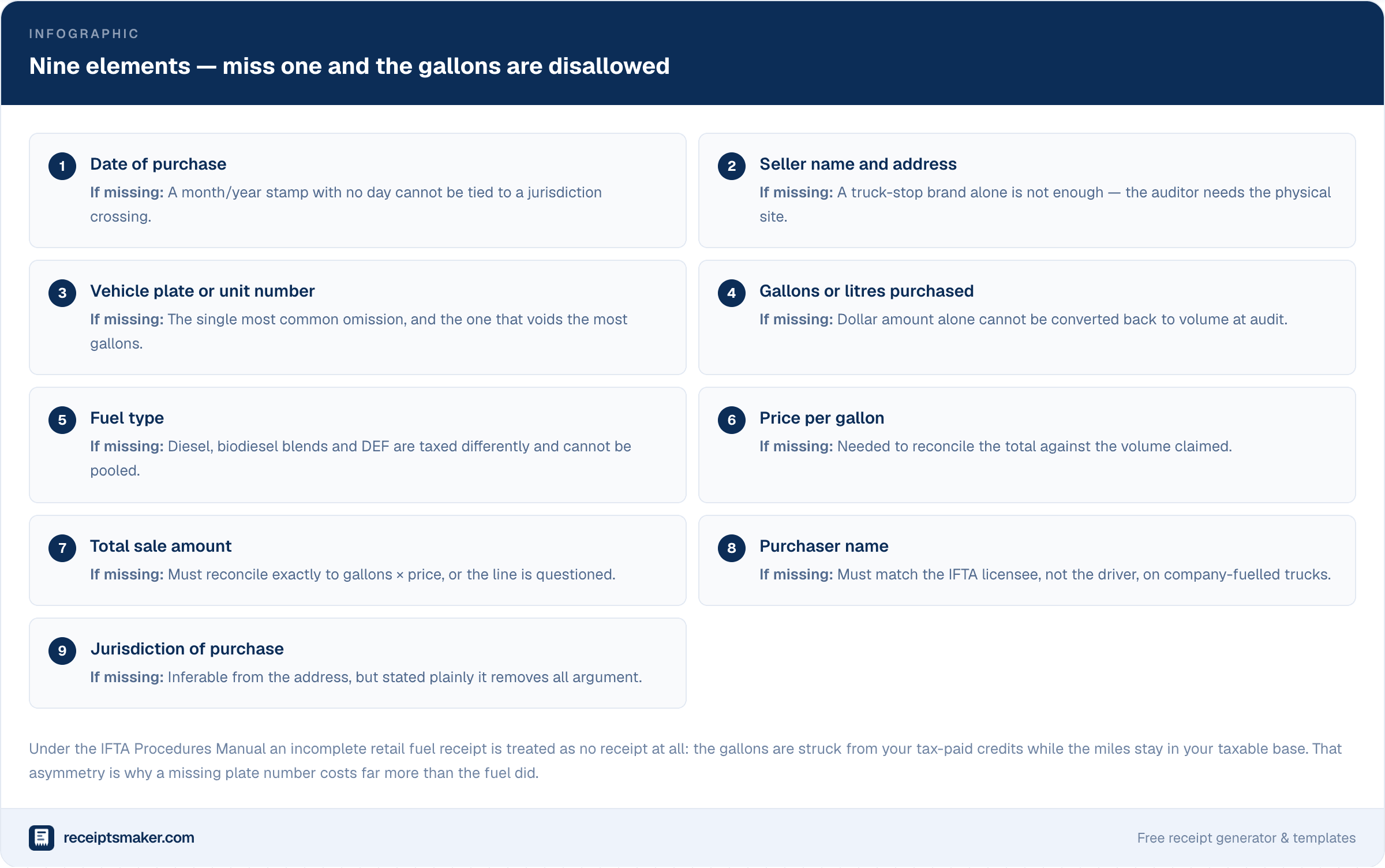
Of the nine required elements, one is missing far more often than the rest: the vehicle identification. Most retail fuel receipts do not print a plate or unit number, because the pump has no idea which truck is filling up.
This puts the burden squarely on the driver. Under the IFTA Procedures Manual the receipt must identify the vehicle, and a receipt that cannot be tied to a specific truck cannot support a credit — the auditor has no way to know the fuel went into an IFTA-qualified vehicle rather than a pickup, a reefer unit, or a personal car.
The remedy is unglamorous and effective: write the unit number on the receipt at the pump, before it goes in the folder. A handwritten annotation made contemporaneously is generally accepted. A batch of plate numbers added months later, in the same pen, on receipts from twelve different states, is not — and it looks precisely like what it is.
Fleet fuel cards solve this properly by encoding the unit number in the transaction, which is the main reason large carriers use them despite the fees.
Retail Fuel Versus Bulk Fuel
The two are documented differently, and carriers who move from one to the other frequently carry the wrong habits across.
| Retail purchases | Bulk storage | |
|---|---|---|
| Primary record | The individual fuel receipt | Withdrawal records from your own tank |
| Credit claimed when | Fuel is purchased | Fuel is withdrawn into a qualified vehicle |
| Also required | Nothing beyond the nine elements | Delivery tickets, inventory reconciliations, tank readings |
| Common failure | Missing plate or unit number | No withdrawal log tying fuel to a specific vehicle |
The bulk fuel rule catches people out because it is counter-intuitive: with bulk storage you claim the credit when fuel leaves the tank into a qualified vehicle, not when the delivery truck fills your tank. That means a withdrawal log is mandatory — date, unit number, gallons, and the jurisdiction where the tank sits. Without it, the entire bulk claim fails regardless of how immaculate your delivery invoices are.
You must also be able to demonstrate that tax was paid on the bulk delivery in the jurisdiction where the tank is located. Untaxed bulk deliveries generate no credit at all.
Do Fuel Card Statements Count as Receipts?
Usually yes, and this is one of the more useful things to know — but with a condition that matters.
A fuel card statement is generally acceptable provided it carries all nine required elements per transaction. Good fleet card reporting does: date, location, gallons, fuel type, price, total, unit number and jurisdiction, line by line. That is a more complete record than most paper receipts, and it is machine-readable.
What does not qualify is a summary statement. A monthly total, or a statement showing dollar amounts without gallons, supports nothing — gallons are the unit IFTA runs on, and a dollar figure cannot be converted back to volume at audit because the price varied at every stop.
Check the detail level of your card provider’s reporting before relying on it as your only record. If it summarises rather than itemises, keep the paper receipts as well.
The Other Half: Mileage Records
Fuel receipts are only one side of the calculation. The distance records are audited just as closely, and a defect there is equally costly.
IFTA requires an Individual Vehicle Distance Record for each trip, showing the date, route, origin and destination, odometer readings, total distance, and — critically — distance broken down by jurisdiction. An electronic logging device or GPS system that records jurisdiction crossings satisfies this comfortably. A hand-written trip sheet can too, provided it is contemporaneous and complete.
What fails is a reconstruction. Distances computed after the fact from a routing program, without underlying trip records, are a standard audit finding — the auditor’s objection is not that the mileage is wrong but that nothing evidences the route actually driven.
Retention and What an Audit Looks Like
IFTA records must be kept for four years from the return due date or the filing date, whichever is later. That is longer than the three-year window applying to many ordinary business records, and it means a receipt from early 2026 stays live well into 2030. Our guide to how long to keep receipts covers how this interacts with the other retention clocks running on the same paperwork.
Jurisdictions are required to audit a percentage of their IFTA licensees each year, so an audit is a routine statistical event rather than an accusation. An auditor will typically sample a few quarters, test the fuel receipts against the reported gallons and the distance records against the reported miles, and — where a defect is systemic — project the error rate across the full period.
That projection is why small, consistent errors are more dangerous than large one-off ones. A missing unit number on most receipts is not nine small problems; it is one finding applied to four years.
There is one more trap worth naming: thermal fuel receipts fade. Truck cabs get hot, receipts sit on dashboards in direct sun, and thermal print is a heat reaction. A receipt that is illegible at audit is a receipt you do not have, whatever the folder says — see what is a thermal receipt for why. Photograph fuel receipts the week they are issued; the four-year window comfortably outlives the paper.
A Routine That Survives an Audit
- At the pump — write the unit number on the receipt before it leaves your hand. This single habit prevents the most common finding.
- Same day — photograph the receipt. Thermal paper will not last four years in a truck.
- Weekly — reconcile receipts against the trip records. A fill-up with no corresponding trip, or a jurisdiction with miles but no fuel, is worth investigating while you still remember the week.
- Quarterly — check the gallons on your return against the sum of your receipts before filing, not after.
- Never — batch-annotate receipts at quarter end. It is visibly a reconstruction and it undermines the credibility of the records that are genuine.
If a receipt is genuinely lost, the honest route is a contemporaneous written record of the purchase supported by whatever corroborating evidence exists — a card statement line, a trip record placing the truck at that location. Our guide to the missing receipt declaration sets out the format. Be realistic about its weight in an IFTA context: a declaration is materially weaker than a receipt here, and a return resting on several of them will attract attention.
For carriers who need to produce their own fuel documentation, our gas and fuel receipt templates include the fields IFTA requires, and the receipt generator lets you add a unit number field directly.
Conclusion
IFTA compliance is not complicated, but it is unforgiving in one specific way: a defective receipt loses you the credit while keeping the tax. Nine elements per receipt, a unit number written at the pump, jurisdiction-level distance records, and four years of retention covers nearly all of it.
The failure that actually costs carriers money is not a dramatic one. It is the missing plate number, repeated quietly across four years of receipts, discovered all at once. Check your current quarter against the nine elements this week — you can see the full IFTA Procedures Manual and current forms at iftach.org.